
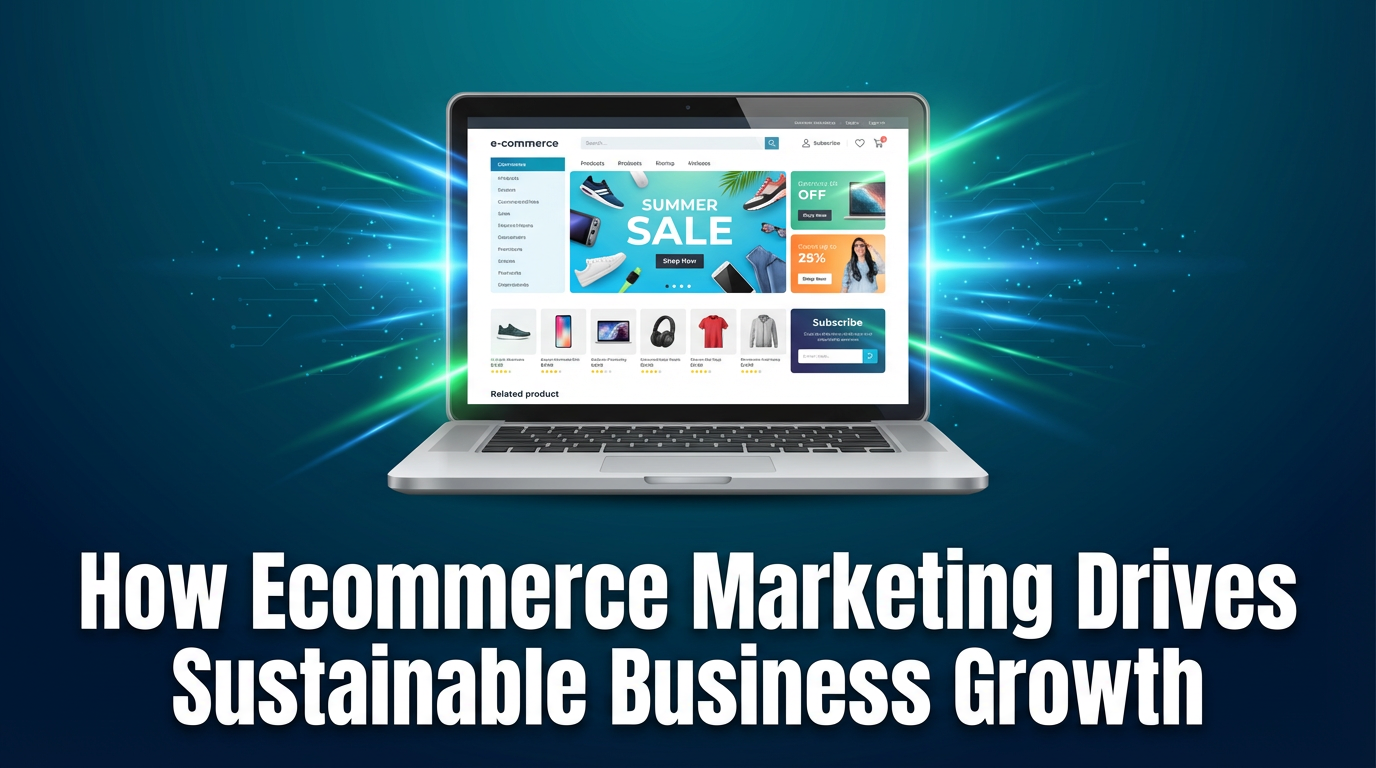
Growth in the cutthroat digital economy of today does not occur by accident. It is accomplished by strategy, accuracy, and constant optimization. Ecommerce marketing must be viewed as a long-term growth engine rather than a temporary strategy for businesses that desire scalable revenue, increased brand authority, and predictable customer acquisition.
Your brand can reach the right audience at the right time through the right channels with the help of a well-planned ecommerce marketing strategy. It integrates data analytics, retention campaigns, traffic generation, and conversion optimization into a single, cohesive system intended for quantifiable business growth.
This blog discusses how ecommerce marketing drives expansion, which tactics are most important, and how to create a framework that consistently produces positive outcomes.
Understanding Ecommerce Marketing and Its Role in Business Growth
The ideas and tactics used to advertise an online business, draw in targeted visitors, turn them into customers, and keep them coming back for more transactions are at the heart of ecommerce marketing. Ecommerce marketing is extremely scalable, data-driven, and quantifiable, in contrast to traditional advertising.
When properly applied, it benefits businesses:
- Boost traffic to eligible websites
- Boost conversion rates
- Increase the lifetime value of your customers
- Lower the cost of acquiring new customers
- Create enduring brand equity
Instead of seeing ecommerce marketing as discrete initiatives, growth-oriented businesses view it as an organized system. The goal of all channels is the same: steady revenue growth.
Building a Growth-Focused Ecommerce Marketing Foundation
Businesses must have a solid foundation prior to posting content or running advertisements. Without it, marketing initiatives can increase visitors but not result in conversions.
1. Clear Brand Positioning
In a competitive market, a compelling value proposition sets your company apart. Consumers ought to comprehend right away:
- What you sell
- For whom is it intended?
- Why it’s superior
- What issue it resolves
Conversions are increased and marketing effectiveness is enhanced by clarity.
2. Optimized Ecommerce Platform
Marketing initiatives must be supported by your website. Crucial elements consist of:
- Quick page loads
- Optimization for mobile
- Safe checkout procedure
- Product descriptions that are clear
- Excellent images
- Clear shipping and price guidelines
Even the most effective ecommerce marketing initiatives are undermined by a badly optimized website.
3. Data and Analytics Setup
Measurable insights are necessary for growth. Companies ought to monitor:
- Sources of traffic
- Rates of conversion
- Cost of acquiring new customers
- Average value of the order
- Value of a customer over time
Ecommerce marketing becomes strategic decision-making thanks to data.
Core Channels That Power Ecommerce Marketing Growth
Multiple channels are used in a good ecommerce marketing plan. Dependence on a single traffic source restricts scalability and introduces danger.
- Search Engine Optimization (SEO)
SEO makes sure your information and items show up when people are actively looking for answers. It provides high-intent, sustained traffic.
Important areas of attention include:
- Product pages optimized for keywords
- Performance of technical sites
- Implementation of structured data
- Content for informative blogs
- approach for internal linking
By creating long-lasting organic presence, SEO improves ecommerce marketing.
- Paid Advertising for Immediate Scale
Paid campaigns offer more focused reach and quicker visibility. Platforms make it possible to precisely segment audiences according to their demographics, interests, and behavior.
Typical paid channels consist of:
- Search engine advertisements
- advertisements for shopping
- Ads on social media
- Campaigns for retargeting
- Advertising on display
In order to maximize return on investment, effective ecommerce marketing employs paid advertising in a systematic manner.
- Email Marketing for Revenue Retention
Gaining clients is costly. It is more profitable to keep them. One of the aspects of ecommerce marketing with the highest return on investment is still email.
Crucial email workflows:
- Greeting sequences
- Recovery of abandoned carts
- Follow-ups following a purchase
- Re-engagement initiatives
- Promotions for loyalty programs
Consistent communication is ensured by automation without adding to the operational burden.
- Social Media Marketing for Brand Authority
Social media platforms facilitate brand storytelling and community development. Social media, when in line with the objectives of ecommerce marketing:
- raises awareness of the brand
- generates traffic from referrals
- promotes content created by users
- supports the effectiveness of paid advertising
Across all platforms, brand recognition is strengthened by consistent messaging and imagery.
Conversion Optimization: Turning Traffic into Revenue
Growth is not assured by traffic alone. To get the most out of your ecommerce marketing, conversion rate optimization is crucial!
- Improve Product Page Performance
Product pages need to have:
- Benefit-oriented descriptions
- Reviews and ratings from customers
- Unambiguous appeals to action
- Signals and assurances of trust
- Product photos with high resolution
Even slight increases in conversion rate have a big effect on overall revenue.
- Simplify the Checkout Process
Cart abandonment is increased by complicated checkout procedures. Companies ought to:
- Reduce the number of form fields
- Provide a variety of payment methods.
- Show guarantees of security
- Give clear shipment schedules.
Ecommerce marketing ROI is improved by a smooth checkout process.
Data-Driven Ecommerce Marketing Strategy
To improve their ecommerce marketing strategy, growth-oriented businesses rely on data.
- Key Performance Indicators (KPIs)
Strategic alignment is ensured by monitoring the appropriate metrics:
- Rate of conversion
- The price per purchase
- Return on investment for advertising
- Value of a customer over time
- Rate of cart abandonment
Continuous improvement is made possible by the analysis of these metrics.
- A/B Testing for Performance Enhancement
Experimenting with various components can greatly enhance results. Among the areas to test are:
- Headlines
- Buttons with calls to action
- Strategies for pricing
- Product pictures
- Layouts for landing pages
When choices are made based on quantifiable outcomes rather than conjecture, e-commerce marketing becomes more effective.
Customer Retention as a Growth Multiplier
While gaining new clients is vital, maintaining existing ones is what propels long-term expansion. Retention-focused businesses increase lifetime value while lowering acquisition expenses. Long-term client connections are given priority over one-time transactions in an effective ecommerce marketing approach.
- Loyalty Programs
Rewarding loyal consumers promotes brand trust and ongoing engagement. Successful loyalty initiatives could consist of:
- Systems of rewards based on points
- Special member savings
- First dibs on new items
- Rewards for referrals
These programs boost brand loyalty and encourage repeat business.
- Personalization and Segmentation
To provide individualized experiences, modern ecommerce marketing employs customer data. Among the examples are:
- Customized product suggestions
- Email campaigns based on behavior
- Personalized promotional deals
- Content for dynamic websites
Customization increases client lifetime value, increases engagement, and increases conversions.
Omnichannel Integration for Scalable Growth
Consumers engage with brands on a variety of platforms. Ecommerce marketing that works successfully incorporates:
- Experience with websites
- Participation on social media
- Paid advertising
- Automation of emails
- Channels for customer service
Maintaining consistency throughout touchpoints enhances brand perception and fosters trust.
Content Marketing as a Long-Term Asset
Good content promotes SEO and engagement while establishing your company as an authority.
Among the successful content strategies are:
- Blog entries that are instructive
- Purchase guides
- Articles that compare products
- Video demonstrations
- Success tales from customers
High-intent audiences are drawn in by content-driven ecommerce marketing, which then nurtures those audiences toward purchases.
Budget Allocation for Maximum ROI
Strategic budget distribution is necessary for growth. Companies ought to distribute resources according to:
- Performance information
- Demand in the market
- The competitive environment
- Trends by season
Investment diversification across channels improves scalability and lowers risk.
Common Ecommerce Marketing Mistakes to Avoid
Steady progress is ensured by avoiding typical traps.
- Dependence on a single source of traffic
- Disregarding mobile optimization
- Not monitoring performance indicators
- Ignoring the retention of customers
- Launching campaigns without doing tests
These problems are avoided by structured ecommerce marketing, which also promotes long-term growth.
Future Trends Shaping Ecommerce Marketing
Competitive advantage is strengthened by staying ahead of industry developments.
Among the new trends are:
- AI-driven customization
- Optimization of voice search
- sophisticated analytics instruments
- Integration of social commerce
- Modeling predictive consumer behavior
Early adopters enjoy quantifiable benefits in ecommerce marketing effectiveness.
How to Build a Scalable Ecommerce Marketing Plan
Use a systematic framework to put a growth-driven strategy into action:
- Research the market and your competitors.
- Establish precise revenue and acquisition objectives.
- Improve the functionality of your website.
- Start campaigns using many channels.
- Track and evaluate KPIs
- Test and improve tactics on a regular basis.
- Pay attention to lifetime value and retention.
Ecommerce marketing becomes a reliable growth engine thanks to this methodical approach.
Measuring Long-Term Business Impact
Long-term effects are where ecommerce marketing really shines. In addition to instant sales, it creates:
- Authority of the bran
- Client confidence
- Predictability of operations
- Stability of revenue
- Competitiveness of the market
Over time, companies that make regular investments experience compounding benefits.
Conclusion: Transforming Growth Through Strategic Ecommerce Marketing
In the digital world, expanding a business involves more than just running advertisements and sharing content on social media. An integrated, data-driven, and customer-focused strategy is needed. The framework for attracting the ideal audience, successfully converting them, and keeping them for long-term profitability is provided by e-commerce marketing.
Businesses establish scalable growth routes by integrating analytics, email automation, paid marketing, SEO, and conversion optimization into a single solution. Ecommerce marketing, when done well, turns online stores into high-performing income generators that can change to meet changing customer needs.
Investing in expert ecommerce marketing is fundamental for businesses looking to grow their operations, gain market share, and generate steady revenue growth.
—————————————————————————————————————————
- What is eCommerce marketing?
The deliberate process of advertising an online store to draw customers, raise sales, and improve customer retention is known as e-commerce marketing.
It drives steady business growth and revenue by combining social media, email campaigns, paid advertising, and SEO.
- What are the 7 types of e-commerce?
B2C, B2B, C2C, C2B, B2G, G2B, and G2C models are the seven categories of e-commerce.
In order to successfully reach its target audience and promote long-term growth, each model needs a unique ecommerce marketing plan.
- What are the 4 types of online marketing?
Search engine optimization (SEO), paid advertising (PPC), email marketing, and social media marketing are the four primary categories of internet marketing.
A solid ecommerce marketing plan that prioritizes traffic, conversions, and long-term expansion is built on these channels working together.
- What does eCommerce mean in marketing?
eCommerce is the term used in marketing to describe the promotion and sale of goods and services via online platforms and digital media.
Through smart ecommerce marketing initiatives, it focuses on bringing in targeted traffic, turning visitors into customers, and maximizing income.
- What are the 7 steps of marketing?
Market research, audience targeting, goal-setting, strategy formulation, content creation, campaign execution, and performance analysis are sometimes referred to as the seven steps of marketing.
These procedures aid companies in effectively scaling revenue, optimizing conversion rates, and methodically attracting traffic in ecommerce marketing.
- Which type of eCommerce is best?
The ideal eCommerce model varies depending on your product, target market, and growth plan; there is no one “best” kind.
When backed by an effective ecommerce marketing plan, B2C and B2B models are frequently the most scalable.
 Get Started